Tuesday, February 5, 2013

White House Looking for Coding Innovators


From the White House Blog:

Throw Your Hat in the Ring for Round 2 of the Presidential Innovation Fellows Program


Todd Park and Steven VanRoekel,  February 05, 2013   09:00 AM EST
We are happy to announce that applications are now being accepted for Round 2 of the Presidential Innovation Fellows program!  You can apply here.
Launched last year, the Presidential Innovation Fellows program recruits top innovators and entrepreneurs from the private sector for 6-12 month “tours of duty” in government to help develop innovative solutions in areas of national significance. Our 18 inaugural Fellows arrived last August, teamed up with top government innovators, and have been doing extraordinary work on five projects:
  • Open Data Initiatives have unleashed data from the vaults of the government as fuel for entrepreneurs and innovators to create new apps, products, and services that benefit the American people in myriad ways and contribute to job growth.
  • RFP-EZ has created a new online marketplace and built tools that make it easier for innovative small tech businesses to bid on government contracts, while also making it easier for government contracting officers to identify the bids that offer the best value for taxpayers.
  • Blue Button for America has moved personal health records ahead significantly by giving millions of veterans and other Americans massively improved, secure access to their own health information. 
  • Better Than Cash is working with an array of foreign and non-governmental partners to transition “the last mile” of international development assistance payments from cash to electronic mobile money, resulting in increased funding transparency and more impact for American taxpayer dollars.
  • MyUSA (formerly MyGov) has reimagined how citizens can interact with government, developing a prototype of an online system that allows people to more easily find and access the information and services that are right for them from across government.   
Throughout the Federal Government, in every agency where Fellows have been working, we’ve been thrilled to see the exciting advances they’ve been achieving in concert with their government teammates. So we are excited to announce that the program is extending and expanding—and that we are ready to welcome applications for our next round of Presidential Innovation Fellows. 
In addition to seeking applicants to work on the next phases of the Open Data Initiatives, MyData Initiatives (including Blue Button for America), RFP-EZ, and MyUSA projects, we are also inviting applications from those who would like to help launch the following new projects:
  • Disaster Response and Recovery will collaboratively build and “pre-position” critical tech tools ahead of future emergencies or natural disasters in order to mitigate economic damage and save lives.
  • Cyber-Physical Systems will work with government and industry to create standards for a new generation of inter operable, dynamic, and efficient “smart systems”—an “industrial Internet”—that combines distributed sensing, control, and data analytics to help grow the economy and new high-value American jobs.
  • 21st Century Financial Systems will work to move the financial accounting systems of Federal agencies out of the era of large-scale, agency-specific implementations to one that favors more nimble, modular, scalable, and cost-effective approaches.
  • Innovation Toolkit will develop a suite of tools that empowers our Federal workforce to respond to national priorities more quickly and more efficiently.
  • Development Innovation Ventures will help enable the US government to identify, test, and scale breakthrough solutions to the world’s toughest problems.
We are looking for incredibly talented, entrepreneurial people from a diverse array of backgrounds and with a wide range of experiences. Many of the Fellowship roles require coding and other tech skills, but not all do. We are also looking for gifted and accomplished change agents with skills in user experience design, product management, project management, business development, operations reengineering, and more.  In a nutshell, we are looking for people who can help make big things happen rapidly to advance the public good.        
So please throw your hat in the ring and apply to be a Round 2 Presidential Innovation Fellow! This is an opportunity to take a journey that will allow you to make an impact on a massive scale. The first step is to apply here.
To learn more about the Presidential Innovation Fellows program and apply to be a Fellow, please visit: WhiteHouse.gov/InnovationFellows
Todd Park is the US Chief Technology Officer and Steven VanRoekel is the US Chief Information Officer.

Thursday, January 17, 2013

Job or Skills Crisis?


A jobs crisis? No, it’s a skills crisis 

A partnership at a Brooklyn high school is preparing students for tech fields that will drive our economy in the 21st century


29
24
0
Print
Buildings stand at the International Business Machines Corp. (IBM) Almaden Research Center campus in the Santa Teresa Hills of San Jose, California, U.S., on Wednesday, July 14, 2010. IBM, the world's biggest computer services company, reported sales that missed analysts' estimates as the falling euro weighed on revenue. Revenue last quarter climbed 2 percent to $23.7 billion. Photographer: Tony Avelar/Bloomberg

TONY AVELAR/BLOOMBERG

The IBM Almaden Research Center campus in Silicon Valley.


Read more: http://www.nydailynews.com/opinion/jobs-crisis-skills-crisis-article-1.1240688#ixzz2IGtsbfrw


As each month’s unemployment figures show only modest declines, some may As each month’s unemployment figures show only modest declines, some may mistakenly believe that the United States has a “jobs crisis.” But a closer analysis of the data reveals that our fundamental challenge is a lack of skills, not jobs.  I made this observation at the recent STEM (Science, Technology, Engineering and Mathematics) Summit convened by the Daily News. But don’t take my word for it. Look at the January 2013 New York City Real Time Jobs Report, which lists local employers that posted the most new ads in the past 90 days and the number of opportunities available.
The current edition of this report documents the existence of more than 300,000 unfilled jobs in the city.

My company, IBM, ranked sixth on the list with nearly 1,000 unfilled jobs in New York City alone. JPMorgan Chase led the way with more than 2,000 unfilled positions, and AT&T and Citigroup together had more than 2,000 careers in search of qualified personnel. A deeper look at the jobs report numbers indicates that 30% of the vacancies — the largest single category — were in the professional, scientific and technical services sector. This is conclusive proof that a focus on preparing our young people for careers in these fields is the crucial economic challenge of our time.

At the summit, we discussed how to address the city’s — and our nation’s — skills crisis. We agreed that one possible solution could be found in the report of Gov. Cuomo’s education reform commission.  Among many other recommendations, that commission called for statewide expansion of the remarkably successful program in operation on one floor of the Paul Robeson High School in Crown Heights, Brooklyn.

The program, Pathways in Technology Early College High School (P-TECH) — a collaboration between the city Education Department, the City University of New York and IBM — offers a combined high school and community college curriculum that is augmented by instruction and mentoring in workplace skills. The rigorous six-year program leads to both a high school diploma and an associate’s degree in applied computer science. Most important, P-TECH grads will be first in line for jobs at IBM.  Recent reports of P-TECH students’ academic success are worth noting. At this juncture, nearly half of the program’s 10th-graders (members of the school’s inaugural class) are already taking and passing college courses, overachieving on the Preliminary SAT and showing additional, quantifiable evidence of progress. This year’s new ninth-graders are doing very well, too.

This new educational model has been replicated in Chicago, where a group of schools modeled on P-TECH opened last fall. They are also excelling.  And U.S. Education Secretary Arne Duncan, who recently visited P-TECH, has endorsed a blueprint to reform career and technical education across the country based on this model.

What is our lesson from this experience? Plainly, it is that through deeper partnerships between the private sector, higher education and K-12 schools, we can close the gap between education and employment  — and reduce joblessness in a lasting way.

By working together, educators and employers can prepare larger and larger numbers of students to take the good jobs that we know are available in our city.

Litow is the president of the IBM International Foundation and IBM’s vice president for corporate citizenship and corporate affairs. Before joining IBM, he served as deputy chancellor of schools for New York City.


Read more: http://www.nydailynews.com/opinion/jobs-crisis-skills-crisis-article-1.1240688#ixzz2IGu8pCo2


Wednesday, January 16, 2013

Nursing Surplus - Temporary?


For nursing jobs, new grads need not apply

@CNNMoney January 14, 2013: 10:33 AM ET


NEW YORK (CNNMoney)

Since the recession, health care has been the single biggest sector for job growth, but that doesn't mean it's easy to get hired.

Registered nurses fresh out of school are coming across thousands of job postings with an impossible requirement: "no new grads."

It's a problem well documented by the nursing industry. About 43% of newly licensed RNs still do not have jobs within 18 months after graduation, according to a survey conducted by the American Society of Registered Nurses.
"The process has become more and more discouraging, especially since hospitals want RNs with experience, yet nobody is willing to give us this experience," saidRonak Soliemannjad, 26, who has been searching for a nursing job since she graduated in June.
New grads have taken to posting their frustrations on allnurses.com, a social network for nurses.
"It is a tough market for a new grad RN. A 'year experience required' or 'not considering new grads at this time' is pretty much the norm," wrote one.
"It's like new grads have a disease or something," said another.
How can this be, at a time when health care jobs are booming and a supposed shortage of RNs sent many career seekers running to nursing school?
The recession is to blame, says Peter Buerhaus, a registered nurse and economist who teaches at the Vanderbilt University School of Nursing. In a paper he co-authored in theNew England Journal of Medicine last year, he shows an interesting phenomenon happens in the demographics of the nursing workforce when the economy is weak.
About 90% of nurses are women, 60% are married, and roughly a quarter are over 50 years old. It's typical for many nurses to take time off to raise children in their 30s, and given the long days spent working on their feet, many often retire in their late 50s.
Prior to the recession, about 73,000 nurses left the profession each year due to childbearing, retirement, burning out or death.
But when the recession hit, spouses lost jobs, 401(k)s lost money, and facing financial uncertainty, fewer nurses chose to leave work, Buerhaus said.
"Many of those nurses are still in the workforce, and they're not leaving because we don't see a convincing jobs recovery yet," Buerhaus said. "They're clogging the market and making it harder for these new RNs to get a job."
At the same time, enrollment in nursing colleges has exploded in recent years. In the 2010-2011 school year, 169,000 people were enrolled in entry-level baccalaureate nursing programs. That's more than double the 78,000 students from a decade earlier, according to the American Association of Colleges of Nursing.
There just aren't enough jobs to go around for all these new grads.
Annah Karam heads recruiting for six hospitals in the Daughters of Charity Health System in Los Angeles. Each hospital has a program in place aimed at hiring at least 10 new grads a year, but the competition is fierce. Karam often receives more than 1,000 applications for each post. For other positions, the hospitals prefer experienced nurses.
"We're new grad friendly but with the challenges we face in the hospital world, we often need seasoned nurses," Karam said. "We hire thousands of nurses across the whole system, yet a very small percentage are new grads."
Eventually, nursing grads should have great job prospects.
Demand for health care services is expected to climb as more baby boomers retire and health care reform makes medical care accessible to more people. As older nurses start retiring, economists predict a massive nursing shortage will reemerge in the United States.
"We've been really worried about the future workforce because we've got almost 900,000 nurses over the age of 50 who will probably retire this decade, and we'll have to replace them," Buerhaus said.
But for recent grads like Soliemannjad, that's not particularly encouraging.
"It just seems that when the experts talk about the economy getting better, they're not talking about it improving in two or three months. They're talking about years," she said. "You have new grads with student loans to pay off. We simply can't not work for another year and half."
Did you earn an advanced degree that did not lead to a job? Was it worth the debt? Send your story to annalyn.kurtz@turner.com. To top of page


STEM Students & STEM Jobs National Report


REGISTER NOW: Official Launch of STEM Students & STEM Jobs National Report

On January 30, 2012 at 3:00pm ET, STEMconnector® and My College Options® will officially launch our new report, Where are the STEM Students? What are their Career Interests? Where are the STEM Jobs? Please click here to register and join over 400 people already participating in the event. The webinar will be a live broadcast of our event launch hosted by the American Association of University Women (AAUW) in Washington, DC.  The event will highlight the major findings of the report, its implication for America’s future workforce and educational needs, as well as special guests including Tennessee Governor Bill Haslam. The full report is available for purchase in addition to a free download of the executive summary online. For more information about the report and event, please read our recent press release.

Monday, January 14, 2013

Ballston for the Creative Class

Reposted from ARLnow:


Leonsis: Ballston Could Be a Haven for the ‘Creative Class’

by ARLnow.com | January 14, 2013 at 1:45 pm 

Ted Leonsis, the billionaire owner of the Washington Capitals and Wizards, says Ballston could soon be known as a haven for entrepreneurs and the “creative class.”
Leonsis made the remarks at a launch event Thursday night for the new Ballston Business Improvement District, which has announced a new campaign to brand Ballston as “home to some of the world’s brightest minds and most innovative industries.” The campaign will capitalize on the fact that the community is home to the Defense Advanced Research Project Agency, the National Science Foundation, the Virginia Tech Research Center, and various science and technology-related companies.
Leonsis, whose Capitals practice at the Kettler Capitals Iceplex in Ballston, said he’s encouraged to see the BID unifying Ballston’s public agencies, private companies and academia around the theme of innovation.
“The community is really coming together to try to stimulate everything about the creative class,” he said.
As part of the BID’s campaign, Leonsis, a former AOL executive, is helping to conduct and underwrite a business competition for entrepreneurs called the Ballston LaunchPad Challenge. He said the winning business idea may receive funding from the $450 million investment fund he set up with AOL co-founder Steve Case.
“We’re here to help and mentor and to help find the next great companies that will start their businesses here and will create employment for residents in Northern Virginia,” Leonsis said.
“Right now there’s this mythology that the only great companies that can get started happen out in Silicon Valley, and that’s not what we adhere to or we believe,” he continued. “We think that there’s a creative class, that there’s unbelievable gifts, talent and infrastructure in Northern Virginia and Washington, D.C. and Maryland — and we want to help stimulate that. We think that there are great young entrepreneurs walking among us.”
Leonsis said the contest, which is just one component of the BID’s overall branding and business improvement effort, will  pay dividends in terms of stimulating economic activity in the area.
“This is a small part of this overall branding and outreach program, but I think it can be a very important part, because jobs are still the number one issue facing our country,” he said. “There’s no more noble, higher calling for an individual to create a company, see your vision come to life, and to employ people. Families get supported, kids get to go to good schools in the community, you start to shop in the mall, you start to eat in the restaurants, and the money stays within the community.”
“This is very strategic not just for Ballston, but for our country,” Leonsis added. ”If we are to make an investment… we want a commitment that you’ll stay in this community that’s treating you and supporting you so well.”
Leonsis said that small business in particular can help ”get young people get back to work” and out of their parents’ homes.
“We should never lose sight of the importance of small business,” he said. “Big companies right now retain earnings and shed jobs. Small businesses are creating all of the new opportunities and all of the innovation that’s keeping us competitive against global competition.”
Leonsis started and ended by addressing a topic that was on the minds of many — one concerning the return of dozens of wealthy individuals to the Ballston area.
“Thank you, and let’s go Caps,” he said, concluding his remarks.

Tuesday, December 4, 2012

C4LPT's New Workplace Learning report focuses on Smart Worker's habits and needs


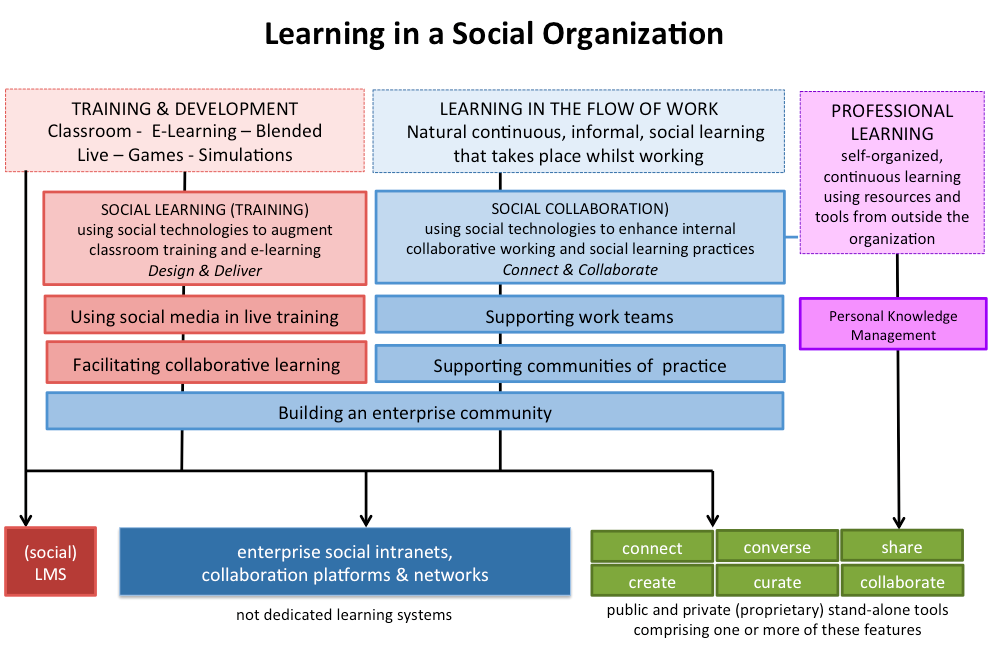
The Centre for Learning and Performance Technologies, keepers of the Top 100 tools for Learning, just released it's New Workplace Learning report for 2013, focusing on how Smart Workers are using online and social tools to address their own learning and performance needs, and in the process are by-passing traditional learning and support structures.  (Click on images for larger version.)

New Workplace Learning (2013)

Work in progress
CONTENTS
Part 1: How the smart worker learns 
It is quite clear that an increasing number of workers are using online social tools to address their own learning and performance needs, and in the process are by-passing both L&D and IT functions. So rather than ignoring the fact or trying to ban access to tools, it is time to re-think how organizations can support today’s smart workers as well as prepare for those of tomorrow.
» Integrate learning in the workflow
»  Provide and enable erformance support
»  Encourage employee generated content
»  Support social networking inside and outside the organisation
»  Encourage social learning both in training and in the workflow
»  Encourage “learning the new” and “entrepreneurial learning”
»  Provide performance consulting services rather than just instructional/training services
» Promote professional learning (outside the organisation) and the use of professional learning portfolios.
====================


Sunday, December 2, 2012

House Republicans get the jump on STEM VISAs

Cross-posted with NoVA STEM Education Network blog:

From Inside Higher Ed
House Passes STEM Jobs Act
December 2, 2012 - 3:00am
The U.S. House of Representatives voted 245-139 on Friday in favor of the Stem Jobs Act, a Republican-backed measure that would make 55,000 visas available for foreign graduates of U.S. universities with advanced degrees in science, technology, engineering or mathematics. The bill is unlikely to progress in the Democrat-controlled Senate. Although there is bipartisan support for visas for STEM graduates, many Democrats oppose a provision of the bill that would eliminate the Diversity Visa Program, which allocates visas for  those coming from countries with low rates of immigration to the United States. The White House opposes the Stem Jobs Act, as does NAFSA: The Association of International Educators, which said, in a statement, “In the acrimonious political debate about immigration reform, we lose our way by embracing a mistaken, zero-sum approach to permanent immigration.”
======

From CNBC:


: